What Happens To Your Mortgage When You Sell Your House In Canada?
Posted on: 09-22-2026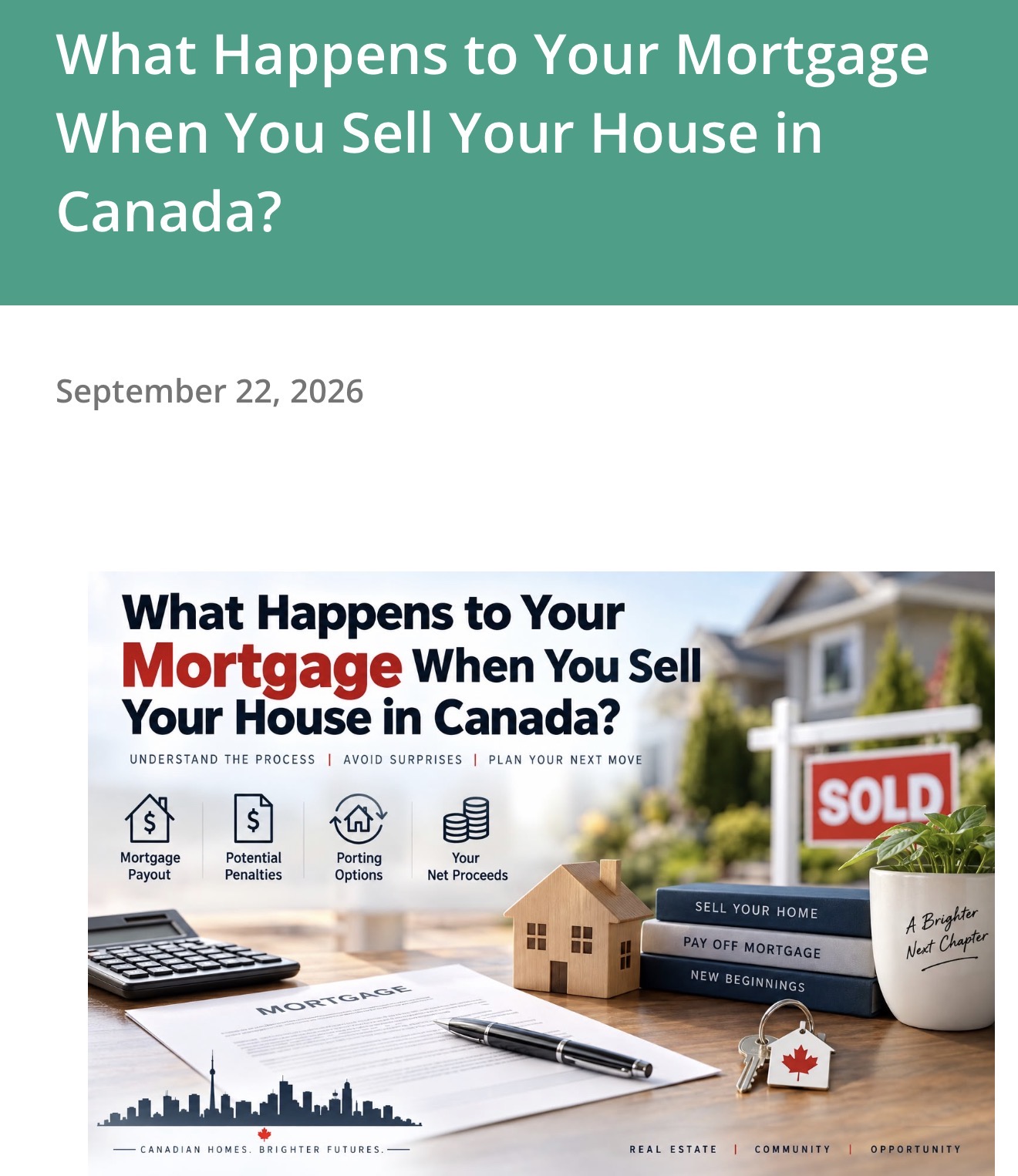
What Happens to Your Mortgage When You Sell Your House in Canada?
Selling your house is a major financial decision, and if you still have a mortgage, one of the first questions you may have is:
"What happens to my mortgage when I sell my house?"
The short answer is that your mortgage generally needs to be paid out when the sale closes. However, the amount you actually need to pay your lender can be different from the mortgage balance you see on your statement.
Depending on your mortgage type, remaining term, lender and circumstances, you may also have to pay a mortgage prepayment penalty, discharge fee or other costs.
If you're planning to sell your home, understanding these costs ahead of time can help you estimate how much money you'll actually have left after the sale.
1. Does selling my house automatically pay off my mortgage?
In most cases, yes.
When you sell a property in Canada, your lawyer handles the closing process and coordinates the payout and discharge of the mortgage registered against the property.
For example, suppose:
Sale price: $600,000
Mortgage balance: $350,000
The mortgage would generally be paid from the sale proceeds at closing.
However, your final mortgage payout could be different from $350,000 because it may include accrued interest, a prepayment penalty, discharge fees or other amounts owing.
The money remaining after the mortgage and other applicable selling costs is your net sale proceeds.
2. Your mortgage balance is not necessarily your mortgage payout
This is one of the most important things sellers should understand.
The balance shown on your mortgage statement is not necessarily the exact amount required to discharge your mortgage on your closing date.
Your lender's payout statement may include:
- Outstanding principal
- Accrued interest
- Prepayment penalty, if applicable
- Mortgage discharge or administration fees
- Other amounts owing under your mortgage
For this reason, sellers should contact their lender before listing their property and ask for an estimated mortgage payout.
3. What happens if you have a closed mortgage?
Many Canadian homeowners have closed mortgages.
A closed mortgage generally limits how much you can pay off before the end of the mortgage term without a penalty.
If you sell your house before the mortgage term expires, you may have to pay a prepayment penalty.
The exact calculation depends on your mortgage contract and lender.
For some mortgages, the penalty may be based on a certain number of months of interest. For others, an interest-rate differential calculation may apply.
Don't assume the penalty will be a specific amount until your lender provides the calculation.
4. What if you have a fixed-rate mortgage?
A fixed-rate mortgage can result in a significant prepayment penalty if you sell before the end of the term.
The amount can depend on factors such as:
- Your outstanding mortgage balance
- Your current interest rate
- The remaining time in your mortgage term
- Your lender's applicable calculation
- The terms of your mortgage agreement
Two homeowners with similar mortgage balances can potentially have very different penalties.
That's why getting a payout estimate directly from your lender is so important.
5. What if you have a variable-rate mortgage?
Variable-rate mortgages can have different prepayment rules.
Depending on the lender and mortgage contract, the penalty may be calculated differently from a fixed-rate mortgage.
If you're considering selling, ask your lender:
"What would my total mortgage payout be if my property closes on [date]?"
This will give you a more realistic number for calculating your expected proceeds.
6. Can you avoid a mortgage penalty by porting your mortgage?
Possibly.
If you're selling your current house and buying another property, your mortgage may be portable.
Mortgage portability allows an eligible borrower to transfer an existing mortgage to another property, subject to the lender's terms and conditions.
Depending on your circumstances, porting may help you avoid or reduce a mortgage prepayment penalty.
However, portability isn't automatic.
Your lender may have requirements regarding:
- The new property
- Purchase price
- Mortgage amount
- Closing dates
- Credit qualification
- Income qualification
- Remaining mortgage term
- Other lender conditions
Before making assumptions, speak with your lender or mortgage professional about whether your mortgage is portable.
7. What if you're buying another home?
If you're selling your current home and purchasing another one, you may have several options.
You could:
- Pay out your existing mortgage and obtain a new mortgage.
- Port your existing mortgage to the new property.
- Port your mortgage and increase the mortgage amount, subject to lender approval.
- Sell your current home first and purchase later.
The best option depends on your financial situation, mortgage terms and plans.
Your REALTOR®, mortgage professional and lawyer can each help with different parts of the process.
8. What happens to a HELOC when you sell?
If you have a Home Equity Line of Credit (HELOC) secured against your property, it generally needs to be dealt with when you sell.
Depending on how it is registered, the HELOC may need to be paid out and discharged along with the mortgage.
For example:
Sale price: $650,000
Mortgage balance: $360,000
HELOC balance: $40,000
That means $400,000 of mortgage-related debt may need to be dealt with from the sale proceeds, before considering other selling expenses.
Don’t forget to include a HELOC when calculating your expected equity.
9. How much money will you actually receive after selling?
Your sale price is not the same as the amount you will receive.
A simplified calculation looks like this:
Sale Price − Mortgage Payout− HELOC or Other Secured Debt − Mortgage Penalty, if applicable − REALTOR® Fees and Applicable Taxes − Legal Fees and Disbursements − Other Selling Costs and Adjustments = Estimated Net Proceeds
For example:
Sale price: $600,000
Mortgage payout: $350,000
HELOC: $25,000
Estimated selling costs: $30,000
Other applicable costs: $3,000
Estimated net proceeds: approximately $192,000
This is only an example. Actual costs vary depending on the property, mortgage, lender, REALTOR® agreement, lawyer and transaction.
10. Why should you know your net proceeds before listing?
Knowing your estimated net proceeds can help you make better financial decisions.
You may be planning to:
- Purchase another home
- Make a larger down payment
- Pay off debt
- Downsize
- Move to another city or province
- Invest your proceeds
- Help family members
- Purchase an investment property
If you don't know your approximate mortgage payout and selling expenses, it can be difficult to determine how much money you'll actually have available after the sale.
11. What if you owe more than your house is worth?
This situation requires careful planning.
Suppose:
Home sale price: $400,000
Mortgage and other secured debt: $425,000
You could have a shortfall before even accounting for other selling expenses.
In this situation, you should speak with your lender and lawyer before proceeding with the sale.
Do not assume that you can simply sell the property and have the mortgage automatically disappear. Your lender will need to be involved in determining how the debt will be handled.
12. What happens to property taxes when you sell?
Property taxes are generally dealt with through the statement of adjustments prepared for closing.
Depending on when you close and how property taxes have been paid, there may be an adjustment between the buyer and seller.
Your lawyer will calculate the applicable adjustment as part of the closing process.
The same principle can apply to other property-related expenses, depending on the property and transaction.
13. What does your lawyer do when you sell?
Your lawyer handles the legal closing process.
Among other things, your lawyer may:
- Review the purchase agreement
- Confirm title requirements
- Obtain mortgage payout information
- Coordinate with your lender
- Pay out the mortgage from the sale proceeds
- Deal with registered debts or liens
- Prepare closing documents
- Complete the transfer of title
- Account for applicable adjustments
- Provide the final statement showing where the sale proceeds went
Your lawyer and lender work together to ensure the mortgage is properly paid out and discharged as part of the transaction.
14. What happens if you have more than one mortgage?
Some homeowners have a first mortgage plus another secured loan, second mortgage or HELOC.
These debts may also need to be dealt with when the property is sold.
This is why it's important to tell your REALTOR® and lawyer about any registered financing connected to the property.
Your lender and lawyer can confirm exactly what must be paid out at closing.
15. What if your closing date changes?
Your mortgage payout can change if the closing date changes.
Interest can continue to accrue, and other amounts may change depending on the new closing date.
If the closing date changes, your lawyer and lender can coordinate updated payout figures.
For this reason, an old mortgage statement should not be treated as the final payout amount.
16. Can you sell your house before your mortgage term ends?
Yes.
Many homeowners sell their property before their current mortgage term expires.
The important issue is understanding the financial consequences of paying out the mortgage early.
Depending on your mortgage agreement, you may have:
- A prepayment penalty
- Discharge fees
- Administration fees
- Other lender charges
- Portability options
Selling before the end of your mortgage term isn't necessarily a problem, but you should know the costs before making your decision.
17. What should you ask your lender before listing?
Before putting your house on the market, consider asking your lender:
- What is my current mortgage balance?
- What is my estimated mortgage payout?
- Would I have a prepayment penalty?
- How is the penalty calculated?
- Can I port my mortgage?
- What are the requirements for portability?
- Do I have a HELOC or other secured debt?
- What discharge fees apply?
- How long is the payout statement valid?
- What happens if my closing date changes?
Having these answers early can make your selling decision much easier.
18. What should you ask your REALTOR®?
Your REALTOR® plays a different role from your lender and lawyer.
A REALTOR® can help you understand:
- Your property's current market value
- Recommended pricing strategy
- Comparable recent sales
- Current market conditions
- Marketing strategy
- Expected REALTOR® fees
- Potential buyer demand
- Negotiation strategy
- Offer terms and conditions
- Expected timeline for the sale
Your lender confirms your mortgage obligations, while your lawyer handles the legal closing and mortgage discharge.
Working with all three can help you make a more informed decision.
19. A simple example of your potential net proceeds
Let's say your home sells for $550,000.
Your estimated costs are:
Sale price: $550,000
Mortgage payout: $320,000
HELOC: $20,000
Estimated REALTOR® fees and applicable taxes: $25,000
Estimated legal and other closing costs: $2,500
Other applicable costs and adjustments: $1,500
Estimated net proceeds:
$550,000 − $320,000 − $20,000 − $25,000 − $2,500 − $1,500 = $181,000
This is only an illustration. Your actual mortgage payout, commission, legal fees, penalties, adjustments and other costs can be different.
20. Your home equity isn't the same as your cash proceeds
Homeowners sometimes calculate their equity like this:
Home value: $600,000
Mortgage: $350,000
Gross equity: $250,000
That doesn't necessarily mean you’ll receive $250,000 after selling.
Selling expenses, mortgage penalties, HELOC balances, legal fees and other costs can reduce the amount you receive.
That's why it's useful to distinguish between:
Gross equity = estimated property value − debts secured against the property
Net proceeds = what remains after the sale and applicable costs are accounted for
21. When should you start planning?
Ideally, before you put your house on the market.
A good starting point is to:
- Contact your mortgage lender.
- Find out your current mortgage balance.
- Ask for an estimated payout.
- Ask about prepayment penalties.
- Check whether your mortgage is portable.
- Identify any HELOC or other secured debt.
- Get an estimate of your home’s current market value.
- Estimate your selling costs.
- Calculate your potential net proceeds.
- Discuss your selling timeline with your REALTOR®.
This can help you decide whether selling now makes financial sense.
22. What happens from accepted offer to mortgage payout?
Once you accept an offer, the transaction moves toward closing.
A simplified process is:
Offer accepted
↓
Conditions are satisfied, if applicable
↓
Buyer and seller complete their respective requirements
↓
Lawyers prepare for closing
↓
Lender provides mortgage payout information
↓
Buyer provides purchase funds
↓
Mortgage and other applicable debts are paid out
↓
Title is transferred
↓
Remaining sale proceeds are provided to the seller
The exact process and timing can vary depending on the transaction and province.
Final Thoughts
Selling a house with a mortgage is extremely common in Canada.
The important thing is not simply knowing how much your home might sell for. You also need to understand what you owe your lender, whether you may have a prepayment penalty, whether your mortgage can be ported and what other selling costs will reduce your proceeds.
Before listing, get an estimated mortgage payout from your lender and discuss your expected selling costs with your REALTOR® and lawyer.
That way, you can make your decision based on your estimated net proceeds rather than just the sale price.
Thinking About Selling Your Home?
If you're considering selling your home in Winnipeg or anywhere in Manitoba, I can help you understand your property's current market value, review recent comparable sales and estimate the potential net proceeds from a sale.
Your lender and lawyer can confirm the exact mortgage and legal figures, while I can help you develop a pricing and selling strategy based on the current market.
Contact me for a no-obligation home value and selling consultation.
Manjot Singh
Trusted Winnipeg REALTOR®
WinMax Real Estate Ltd.
More Posts
Downsizing In Winnipeg: A Practical Guide For Homeowners
How To Analyze A Winnipeg Rental Property Before You Buy: A Complete Investor Guide
What Happens To Your Mortgage When You Sell Your House In Canada?
Selling Your Vacation Home Or Cabin In Manitoba: What Owners Need To Know
Is Buying During Winnipeg’s Parade Of Homes A Smart Move?
Selling Your Parents' Home When They Move Into Assisted Living Or A Retirement Residence In Winnipeg
How To Buy A Home In Winnipeg And Rent Part Of It To Help Pay Your Mortgage
How To Sell A Luxury Or Executive Home In Winnipeg: A Complete Seller’s Guide
How To Sell Vacant Land In Winnipeg: The Complete Guide For Property Owners
The Ultimate Winnipeg Closing Day Checklist For Buyers And Sellers
Can I Sell My House Without Paying Capital Gains Tax In Canada?
How To Sell An Inherited Property In Winnipeg: A Complete Guide For Executors And Beneficiaries
How To Save For A Down Payment In Canada: A Complete Guide For First-Time Home Buyers
DIVORCE AND REAL ESTATE IN WINNIPEG: WHAT HAPPENS TO THE FAMILY HOME?
What To Check When Viewing A House In Winnipeg: The Ultimate Buyer’s Guide
NIGERIANS BUYING A HOME IN WINNIPEG: THE COMPLETE GUIDE FOR FIRST-TIME BUYERS, NEWCOMERS & INVESTORS
WHY WINNIPEG HOMES SELL OVER ASKING PRICE - Offer Day, Bidding Wars & “Offers As Received” Explained
WINNIPEG HOME BUYER REBATES, TAX CREDITS & INCENTIVES IN 2026: COMPLETE GUIDE TO SAVING THOUSANDS
SELLING A TENANT-OCCUPIED PROPERTY IN WINNIPEG: THE COMPLETE LANDLORD GUIDE
Selling Your Home Without A Realtor In Winnipeg - The Complete FSBO Guide
Understanding The Home Buying Process: A Step-by-Step Guide
Should You Renovate Before Selling Your Home In Winnipeg? (What Actually Adds Value)
Selling & Buying A Home At The Same Time In Winnipeg (Complete Guide)
Important Things To Do When Moving Into A New Home
Selling Your Home In Winnipeg: Tips For A Fast And Profitable Sale
The Ultimate Guide To Buying A Pre-Construction Home
How To Choose The Right Realtor For Your Home Sale
The Ultimate Guide To Buying A Home In Winnipeg
Top Neighborhoods In Winnipeg For Home Buyers: Best Areas To Live
Flipping Houses In Winnipeg: The Investor’s Guide To Finding And Renovating For Profit
Choosing A Top Realtor In Winnipeg: The Ultimate Guide For Home Buyers And Sellers
Power Of Attorney Home Sale In Winnipeg | Expert Realtor Guide
A Guide For Nigerians Moving To Winnipeg - What To Know Before Buying Your First Home
Why Many Nigerians Are Investing In Duplexes And 4-Plexes In Winnipeg
Selling A Home “As-Is” In Winnipeg: What Sellers Need To Know (And When It Makes Sense)
Realtor Explains Which Winnipeg Neighborhoods Investors Should Watch In 2026
New Build Vs Resale Home In Winnipeg: Which Is Better For You?
Buying A New Build Home In Winnipeg: Complete Costs, Process & Mistakes To Avoid
What Really Helps You Sell Your Home For A Higher Price In Winnipeg
Off-Market Homes In Winnipeg: What Buyers Should Know
What Is My Home Worth In Winnipeg In 2026? A Complete Guide For Homeowners
Avoid These Common Mistakes When Selling Your Home In Winnipeg - 2026 Edition
Moving To Winnipeg: Complete Relocation Guide For Buyers & Investors
First-Time Home Buyer GST Rebate In Winnipeg (2026 Complete Guide)
Winnipeg Infill Duplex & Multi-Family Homes: Investment Guide (2026)
The Complete Guide For Home Sellers In Winnipeg (2026 Edition)
How Much Does It Cost To Sell Your Home In Winnipeg? A Realtor Explains
Work Permit Holders Can Buy Homes In Canada - Here’s How (2025 Guide)
How Much Does It Cost To Buy A Home In Winnipeg? A Realtor Explains
Buying An Older Home In Winnipeg: Risks, Benefits, What Buyers Should Know