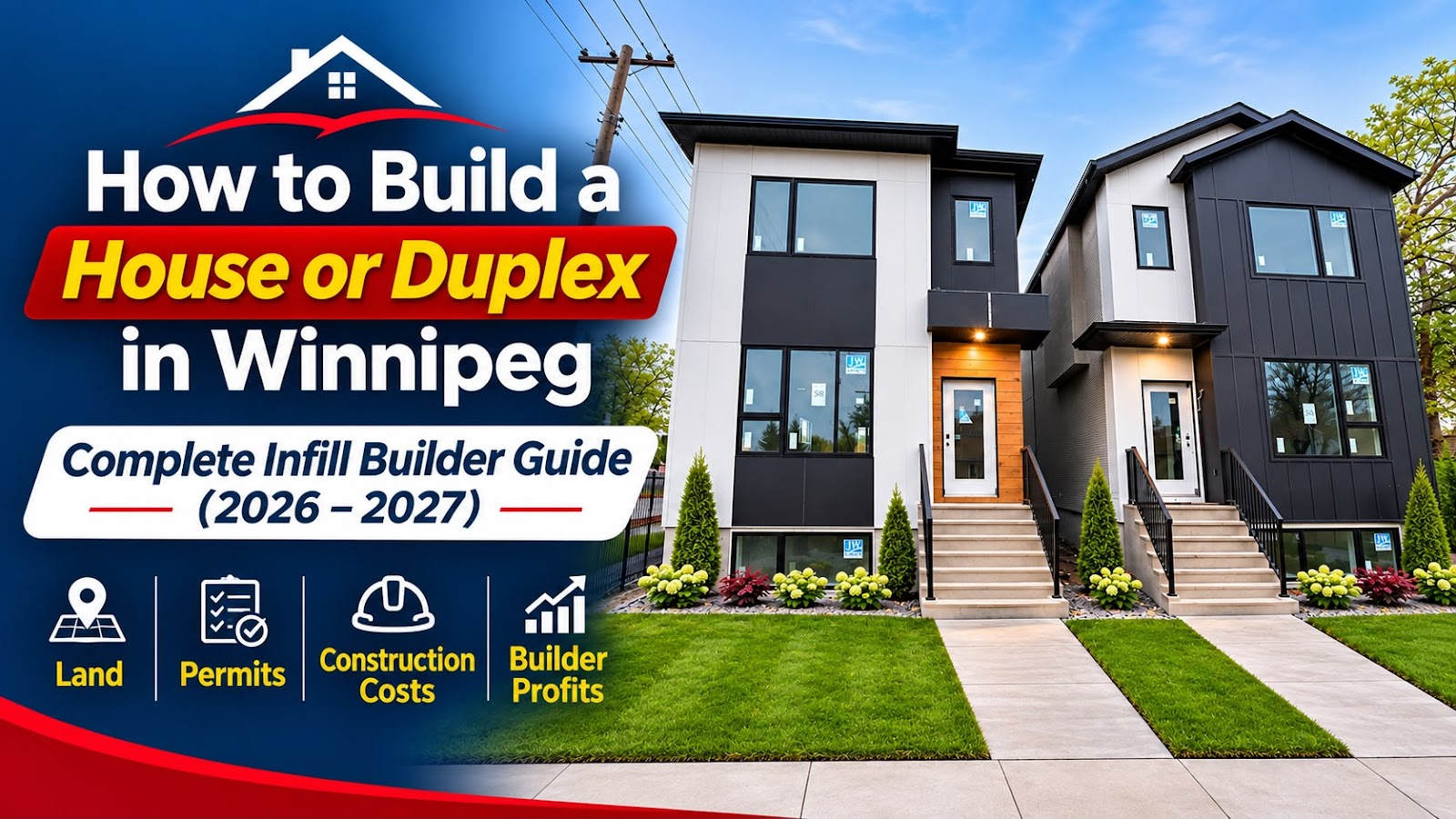
Thinking about becoming an infill builder in Winnipeg? Whether you’re planning to build your first house, construct a duplex with a secondary unit, or develop multiple properties for resale, understanding the process before buying land can save you thousands of dollars.
Infill construction continues to create opportunities in established Winnipeg neighbourhoods such as St. Vital, Fort Garry, River Heights, St. James, East Kildonan, West Kildonan, North Kildonan, Transcona, and Weston.
But building a house or duplex involves much more than buying an older bungalow and hiring a contractor. You need to understand zoning, land subdivision, construction financing, City permits, demolition, water and sewer servicing, construction costs, and potential resale profits.
How much money do you need to start building? How long does construction take? And can a builder make $50,000–$80,000 on a completed duplex?
I’m Manjot Singh, your Trusted Winnipeg REALTOR® with WinMax Real Estate Ltd. I work with homebuyers, investors, and infill builders searching for suitable land, redevelopment opportunities, and newly constructed properties throughout Winnipeg.
This complete 2026 - 2027 guide explains how to become an infill builder in Winnipeg, including a practical two-duplex development example with estimated costs and potential profit.
1. What Is Infill Construction in Winnipeg?
Infill construction means building new residential properties on vacant or previously developed land in established neighbourhoods.
For example, a builder may purchase an older bungalow, demolish it, and construct a brand-new house or duplex.
Depending on zoning and approvals, possible developments include single-family homes, up/down duplexes, side-by-side duplexes, homes with secondary suites, triplexes, and fourplexes.
One popular strategy involves purchasing a suitable double lot and building two separately saleable duplex properties, each with two residential units.
These properties may appeal to investors seeking rental income and homeowners interested in offsetting mortgage expenses.
2. Where Can You Buy Land for Infill Construction?
There are three common options.
Vacant Infill Lots: Empty residential lots in established neighbourhoods may be suitable for custom homes or duplexes, depending on zoning, servicing, and access.
Older Houses for Demolition: Builders purchase older bungalows primarily for land value, demolish the existing structures, and develop new housing. Properties with suitable lot widths, rear-lane access, or underlying lot lines may offer redevelopment opportunities.
Lots in New Developments: In larger residential developments, lots are often allocated to participating builders. Buyers may need to purchase a lot and construction package together, depending on the developer’s arrangements.
Before purchasing, review the legal description, zoning, lot dimensions, rear-lane access, existing utilities, demolition requirements, and potential resale value.
Builder tip: A 50-foot lot doesn’t automatically qualify for two houses or duplexes. Confirm the development potential before removing purchase conditions.
3. Winnipeg Schedule AC: Can You Build a Duplex on a 25-Foot Lot?
The City of Winnipeg Zoning By-law 200/2006 includes Schedule AC, which establishes development standards for certain low-density infill housing projects.
Schedule AC can apply to qualifying two-family, three-unit, and four-unit developments in R1, R2, and RMF-S zoning districts.
Some important minimum lot-width provisions include:
|
Development Type |
Minimum Width Under Specified Conditions |
|
Two-family dwelling with paved or gravel public rear lane |
25 feet |
|
Two-family dwelling on qualifying corner lot with side approach and no rear lane |
35 feet |
|
Semi-detached dwelling with paved or gravel public rear lane |
40 feet |
|
Two-family dwelling in other circumstances |
50 feet |
|
Three-unit dwelling in R1 with qualifying paved rear lane |
35 feet |
|
Four-unit dwelling in R1 with qualifying paved rear lane |
50 feet |
These widths are not automatic development approvals. Other requirements concerning lot area, access, setbacks, building design, servicing, and parking may apply.
Can You Split a 50-Foot Lot Into Two 25-Foot Lots?
Potentially, depending on the property’s legal configuration and applicable approvals.
Some older Winnipeg properties contain two underlying legal lots even though one house occupies the entire property. Others require a formal subdivision or land-division process.
In one Winnipeg planning inquiry, the City indicated that a 50-foot property with an underlying lot line could potentially accommodate one duplex on each of two 25-foot lots under Schedule AC, subject to servicing and development requirements.
However, the City did not support two detached single-family houses on those same lots under the circumstances reviewed.
This illustrates why the legal lot boundaries and proposed building type must be checked separately.
Variances and Subdivision Fees
A variance permits certain deviations from zoning requirements when approved. A subdivision creates new legal parcels through the applicable process.
The City’s published 2026 application fee information includes approximately $4,490 for a short-form subdivision and $8,370 for a full subdivision. Survey, legal, registration, and servicing expenses may be additional.
City zoning information:https://www.winnipeg.ca/building-development/zoning
4. Building an Up/Down Duplex With a Secondary Unit
An up/down two-unit property is a popular Winnipeg infill development option.
For example, a new duplex may include:
Main Unit: Three bedrooms, two bathrooms, open-concept living and dining areas, kitchen, laundry, and a separate entrance.
Secondary Unit: Two bedrooms, one bathroom, kitchen, living area, laundry, and a separate entrance.
Depending on the approved building design, the additional unit may be located in the basement or on the second floor.
A two-family dwelling and a principal dwelling with a secondary suite are not necessarily classified identically under zoning and building regulations. Confirm the correct classification with the City before finalizing plans.
Important design considerations include fire separation, sound insulation, heating and ventilation, separate entrances, parking, laundry, and utility arrangements.
How Much Does a Secondary Unit Cost?
For this guide, we’ll use an estimated additional allowance of $40,000 per secondary unit, whether located in the basement or on the second floor, assuming the builder’s base construction quote already includes the required structure.
Actual costs depend on the approved design and the scope included in the base price. Builders should obtain a detailed quotation to avoid double-counting or missing work.
5. How Much Does It Cost to Buy and Prepare a Double Lot?
Let’s use an example of purchasing an older bungalow on a suitable double lot in St. Vital or Fort Garry.
The goal is to demolish the existing house and build two separately saleable duplex properties, subject to zoning and City approvals.
Estimated Land and Site Preparation Costs
|
Expense |
Total for Two Lots |
|
Double lot purchase |
$320,000 |
|
Demolition, water and sewer servicing |
$45,000 |
|
Total land and site preparation |
$365,000 |
|
Allocated cost per duplex lot |
$182,500 |
The $45,000 is a combined preliminary allowance for demolition and water/sewer work. Actual servicing costs may be higher or lower depending on the property.
The allocated cost of $182,500 per duplex includes half of the land purchase and half of the combined site preparation allowance.
6. How Much Does It Cost to Build a Duplex in Winnipeg?
Construction costs depend on the builder, property design, materials, finishes, foundation, and included scope.
For this example, we’ll use an estimated base construction price of $190 per square foot, with an additional $40,000 for the secondary unit.
The base construction price is assumed to include the foundation and unfinished basement or applicable building structure. The secondary-unit allowance covers the additional work specified in the builder’s quotation.
City permits, demolition, and water and sewer servicing are not included in the $190 per-square-foot rate and are budgeted separately.
Construction Cost Per Duplex
|
Expense |
Estimated Cost |
|
Main construction: 1,550 sq. ft. × $190 |
$294,500 |
|
Secondary unit allowance |
$40,000 |
|
Total construction cost per duplex |
$334,500 |
|
Construction cost for two duplexes |
$669,000 |
The example assumes the 1,550 square feet is the area to which the builder applies the $190 rate. The final contract should clearly define the measured area and inclusions.
7. City Permits, Development Fees and Refundable Deposits
Builders should understand the difference between permanent City expenses and refundable security deposits.
Development Permit
A development permit addresses compliance with applicable zoning and land-use requirements.
The City’s published 2026 housing development permit information includes a $165 base fee, with additional charges depending on the project.
Building Permit
A building permit addresses construction requirements under applicable building regulations.
The published 2026 fee schedule for new single- and two-family construction includes a $260 base fee plus $5.30 per square metre of applicable floor area.
Additional plumbing, electrical, and secondary-suite-related fees may apply.
Demolition Permit
Demolishing an existing house generally requires a demolition permit.
The City’s published 2026 fee information includes approximately $454 for residential house demolition, with a reduced fee of approximately $260 in certain qualifying circumstances.
The demolition contractor’s cost is separate from the permit fee.
Water and Sewer Servicing
An older bungalow may have one existing water and sewer connection. Building two separate properties may require new or upgraded services.
Actual costs depend on existing infrastructure, service locations, and the City’s requirements.
Our financial example includes demolition and water/sewer servicing in the combined $45,000 site preparation allowance.
Refundable City Deposits
Builders may also need to provide lot-grading deposits or other development-related security.
The City’s published residential lot-grading information lists a $205 permit fee and a $2,700 refundable deposit per applicable lot.
For two qualifying lots, that would mean $410 in permit fees and $5,400 in refundable deposits.
Some projects may involve other security requirements, so a builder should confirm the exact amount with the City.
Important: A refundable deposit affects the cash needed during construction, but it should not be treated as a permanent project expense if the refund requirements are satisfied.
City fees: https://www.winnipeg.ca/building-development/fees-charges
The fee figures above are based on published 2026 information. Builders starting in 2027 should confirm the applicable schedule before applying.
8. How Does Construction Financing Work?
Construction financing is different from a conventional home mortgage.
Many lenders release funds through progress draws as construction advances.
These draws may occur after foundation completion, framing, lock-up, interior construction, and final completion.
A lender may require approved plans, construction estimates, permits, appraisals, insurance, a construction contract, and information about the builder’s experience.
For example, if a lender finances 75% of the $320,000 land purchase, the builder would need approximately $80,000 for the land down payment, plus closing expenses and any other required upfront cash.
However, construction financing requirements vary significantly. Some lenders require more equity, additional security, or presales.
Builders should also maintain sufficient working capital to pay contractors before draws are released.
Interest, lender fees, construction delays, and other carrying expenses should be calculated separately.
9. Complete Cost Breakdown: Building Two Duplexes in Winnipeg
Now let’s combine the major expenses into one realistic development example.
Assume:
- Location: St. Vital or Fort Garry.
- Double lot purchase: $320,000.
- Two duplexes, each approximately 1,550 sq. ft.
- One additional secondary unit per duplex.
- Construction rate: $190 per sq. ft.
- Secondary-unit allowance: $40,000 each.
- Selling price: $620,000 per duplex.
Estimated Cost Per Duplex
|
Expense |
Estimated Cost |
|
Land and site preparation |
$182,500 |
|
Main construction: 1,550 sq. ft. × $190 |
$294,500 |
|
Secondary unit |
$40,000 |
|
Appliances for both units |
$10,000 |
|
Air conditioning |
$6,000 |
|
Landscaping |
$4,000 |
|
Realtor commission allowance |
$17,500 |
|
City permits, legal and land transfer tax allowance |
$7,000 |
|
Total estimated cost per duplex |
$561,500 |
The realtor commission allowance is calculated at 4% of the $620,000 selling price after deducting the allocated $182,500 land and site cost, as an example of a negotiated commission structure.
Actual commission is determined by the listing agreement. GST on commission, if applicable, must also be accounted for.
The $7,000 City/legal/land-transfer allowance is illustrative and must be tested against actual permit requirements and closing costs. Financing, carrying costs, GST adjustments, income tax, and contingency are not included in this table.
Estimated Total for Two Duplexes
|
Item |
Amount |
|
Combined selling price |
$1,240,000 |
|
Combined estimated project costs shown above |
$1,123,000 |
|
Remaining margin before excluded expenses and taxes |
$117,000 |
This represents approximately $58,500 per duplex before financing, applicable GST adjustments, income tax, contingency, and any unbudgeted costs.
It is not a guaranteed net profit.
10. How Much Profit Can an Infill Builder Make in Winnipeg?
A builder may aim for approximately $50,000–$80,000 in profit per completed house or duplex, depending on the land price, construction costs, resale value, and project efficiency.
However, this should be treated as a development target rather than a typical or guaranteed return.
In our example:
Selling price per duplex: $620,000
Estimated listed costs per duplex: $561,500
Remaining margin: $58,500
This margin can be reduced by construction financing, GST adjustments, income taxes, unexpected expenses, and delays.
What Happens If the Secondary Unit Costs More?
If the secondary-unit allowance increases from $40,000 to $50,000, the margin decreases by $10,000 per duplex, assuming everything else remains unchanged.
Similarly, if the land purchase price or servicing costs increase, the project’s potential return decreases.
This is why successful builders often calculate the expected resale value first and then determine the maximum price they can afford to pay for land.
Builder tip: A property that appears inexpensive to purchase isn’t necessarily a profitable development opportunity. Always calculate the complete project.
11. How Much Can a New Duplex Sell for in Winnipeg?
The selling price depends on the neighbourhood, property size, layout, bedroom count, finishes, parking, and market conditions.
The following are indicative asking-price ranges based on inventory examples and pricing assumptions, not verified neighbourhood-wide sold-price averages.
|
Winnipeg Neighbourhood |
Indicative Duplex Price |
|
Weston |
$499,900–$520,000 |
|
St. James |
$560,000–$590,000 |
|
East, West and North Kildonan |
$560,000–$590,000 |
|
Transcona |
$560,000–$590,000 |
|
St. Vital |
$600,000–$650,000 |
|
Fort Garry |
$600,000–$650,000 |
|
River Heights |
$700,000–$800,000 |
Our financial example uses a $620,000 selling price in St. Vital or Fort Garry.
Before purchasing a development property, review recent comparable sales for the exact location and proposed building design.
12. How Long Does It Take to Build an Infill House or Duplex?
For many standard Winnipeg infill projects, construction may take approximately 6–12 months after work begins, depending on the builder and complexity.
A straightforward project may be completed in approximately 6–8 months, while larger or more complicated developments may require 9–12 months or longer.
This timeline generally excludes land acquisition, financing, drawings, subdivision, and preliminary City approvals.
Weather, contractor availability, materials, inspections, and utility connections can also affect completion.
Step-by-Step Construction Process
1. Find a suitable vacant lot or older house for redevelopment.
2. Review zoning, Schedule AC, legal boundaries, and servicing.
3. Calculate development costs and expected resale value.
4. Arrange construction financing and available equity.
5. Prepare architectural drawings, engineering, and surveys.
6. Obtain applicable City approvals and permits.
7. Complete demolition and site preparation.
8. Complete excavation, servicing, and foundation construction.
9. Complete framing, roofing, windows, and exterior work.
10. Install plumbing, electrical, heating, ventilation, and insulation.
11. Complete drywall, kitchens, flooring, bathrooms, and secondary units.
12. Complete landscaping, grading, inspections, and applicable certifications.
13. Sell the completed property or arrange rental financing.
The sequence and timeline vary by project.
13. GST, Taxes, Insurance and New-Home Warranties
Before calculating final profit, builders should account for the following:
GST: New residential construction may create GST obligations. The treatment depends on the transaction and property use. Eligible rebates or input tax credits may apply in certain circumstances, subject to CRA rules.
Income Tax: Profits from constructing and selling homes may be treated as business income. Incorporating a company doesn’t automatically eliminate taxes.
Insurance: Appropriate construction and liability insurance should be arranged before work begins.
Warranties: Warranty obligations and coverage depend on applicable legal requirements, the warranty provider, and the construction contract.
Official CRA website: https://www.canada.ca/en/revenue-agency.html
Consult a qualified accountant and lawyer before starting a development project.
14. Common Mistakes First-Time Infill Builders Should Avoid
Buying Without Confirming Zoning: A 50-foot lot doesn’t automatically qualify for two houses or duplexes.
Ignoring Legal Lot Boundaries: Underlying lots and newly created subdivisions are not the same.
Underestimating Servicing Costs: Water and sewer upgrades can significantly affect profitability.
Forgetting Refundable Deposits: Even refundable City deposits require temporary cash.
Comparing Builders Only by Square-Foot Price: Confirm the exact construction scope and exclusions.
Insufficient Working Capital: Construction draws may not match contractor payment schedules.
Overestimating Resale Value: Use comparable sold properties rather than optimistic asking prices.
Ignoring Financing and Taxes: These expenses can substantially reduce final profit.
No Contingency: Unexpected construction costs can quickly change the project’s financial outcome.
15. Frequently Asked Questions About Building in Winnipeg
Can I build a duplex on a 25-foot lot?
Potentially, if the property meets applicable Schedule AC requirements, including qualifying access, servicing, and other standards.
Can I build two duplexes on a 50-foot lot?
Potentially, depending on legal lot boundaries, zoning, servicing, and City approvals.
Can I build a secondary unit in the basement or second floor?
A qualifying two-unit design may be possible. The location, building classification, and approved plans must meet the applicable requirements.
How much does it cost to construct a 1,550-square-foot duplex?
Using this guide’s assumptions, the base construction cost is approximately $294,500, plus $40,000 for the secondary unit. Land, permits, demolition, servicing, and other development expenses are separate.
How much money do I need to start?
It depends on the land price, lender requirements, and construction budget. Our example assumes an $80,000 land down payment if a lender finances 75% of the $320,000 purchase, but additional upfront cash will be needed.
How long does construction take?
Approximately 6–12 months for many standard projects after construction begins, excluding preliminary approvals and financing.
Can a builder make $50,000–$80,000 per duplex?
That may be a development target, but it is not guaranteed. Our example produces a $58,500 margin per duplex before financing, taxes, contingency, and other excluded expenses.
Is it better to build and sell or keep the duplex as a rental?
That depends on expected resale profit, rental income, financing, operating expenses, taxes, and long-term investment goals.
16. Interested in Buying a Completed Infill Duplex Instead?
Not everyone wants to manage land acquisition, demolition, permits, contractors, and construction financing.
If you’re interested in purchasing a brand-new duplex ormultifamily investment property instead of building one yourself, I’ve prepared a separate guide for buyers and investors.
Read: Winnipeg Infill Duplex & Multi-Family Homes: Investment Guide
https://manjotsinghrealtor.ca/winnipeg-infill-duplex-multi-family-homes-investment-8
That guide explains buying completed infill properties, rental income potential, neighbourhood considerations, and long-term investment opportunities.
Final Thoughts: Start With the Right Land and the Right Numbers
Building a new house or duplex in Winnipeg can be a rewarding opportunity for homeowners, investors, and aspiring builders.
However, successful development starts with finding the right property, confirming zoning, understanding City requirements, arranging financing, and preparing an accurate construction budget.
In our example, two duplexes selling for $620,000 each generate $1,240,000 in gross sales. After the listed estimated costs of $1,123,000, approximately $117,000 remains before financing, applicable tax adjustments, contingency, and other excluded expenses.
That illustrates why land acquisition price, construction efficiency, and resale value are critical to profitability.
The goal isn’t simply to build a new house or duplex. It’s to purchase the right land, develop efficiently, and complete a financially sustainable project.
Looking for Infill Lots or Teardown Properties in Winnipeg?
Whether you’re planning your first custom home, searching for a 50-foot double lot, looking for an older bungalow to demolish, or exploring duplex development opportunities, I can help you identify suitable properties and coordinate due diligence with qualified professionals.
I work with homebuyers, investors, and infill builders throughout Winnipeg and surrounding communities.
Planning your first infill project? Contact me before purchasing land.
Manjot Singh | REALTOR®
WinMax Real Estate Ltd.
Your Trusted Winnipeg REALTOR®
Phone: 204-999-2105
Website: https://manjotsinghrealtor.ca
Disclaimer: This guide is for general educational purposes. All construction costs, resale prices, financing examples, profit targets, and timelines are illustrative and subject to change. City fees referenced are based on 2026 information and should be reconfirmed for 2027. The financial example excludes certain financing costs, GST adjustments, income taxes, contingency, and unbudgeted expenses. Actual zoning, servicing, permits, refundable deposits, construction scope, and project feasibility must be verified for each property. Consult qualified construction, legal, engineering, lending, and tax professionals before making financial commitments.